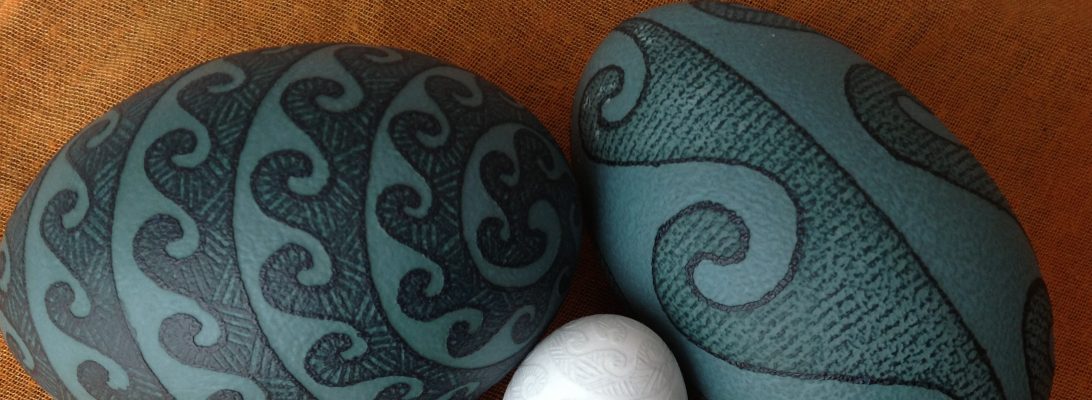

The first attempt has been described in the previous post here. I needed to try to increase the concentration of the dye, or so I thought.
My first “recipe” was: 50g brazilwood, 500 ml water. Soaked overnight. Simmered for 15 min, added alum.
Second “recipe”: 200g Brazil wood, 1000 ml of distilled water (tried 500, but that was not enough to have the bath liquid), 2/3 of tums tablet. Simmered for about 3 hours, added alum.


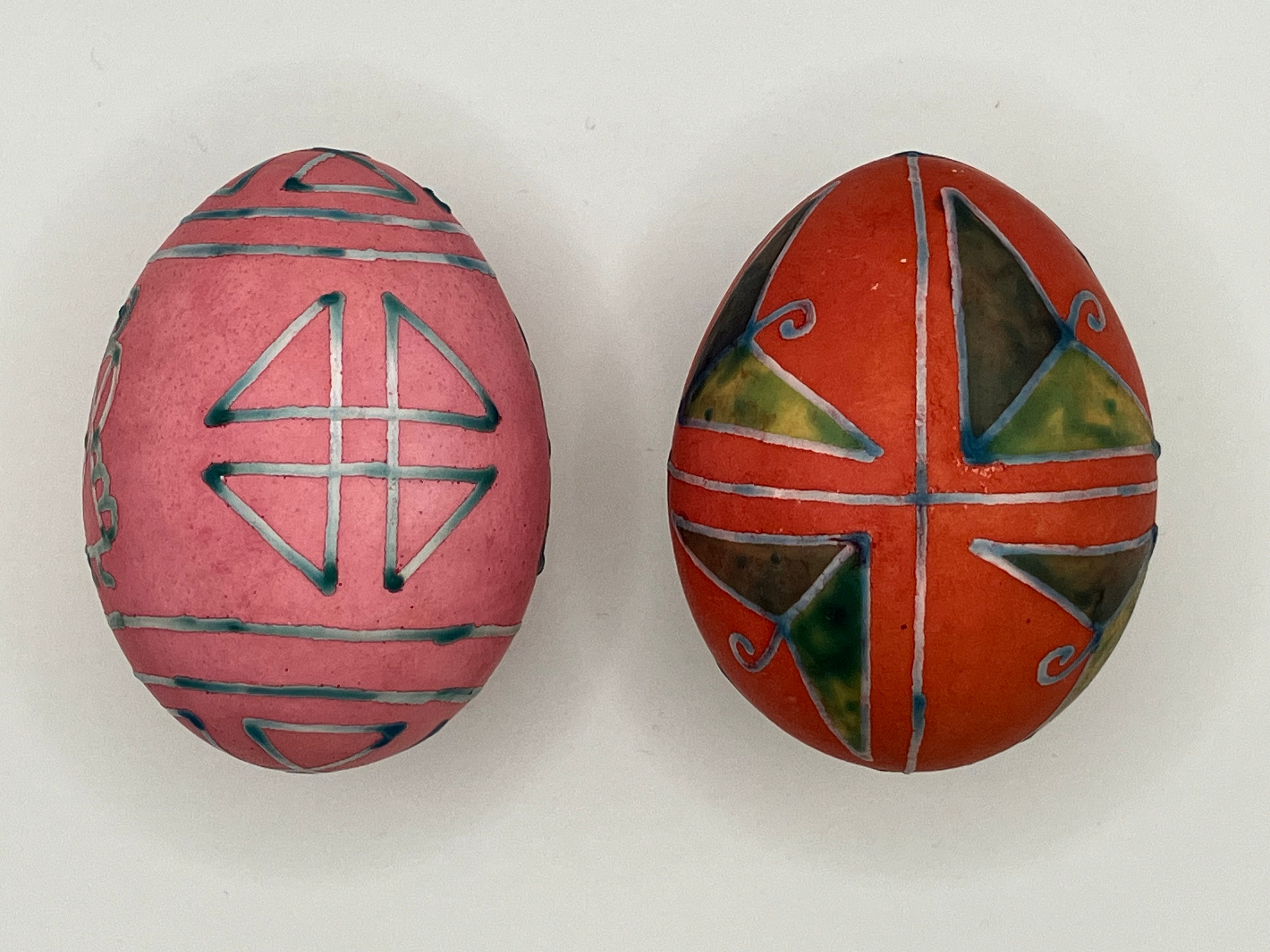
It was not working much better than before, the white egg was still just pink, the yellow one was too orange, not red enough. Then I flipped and added a LOT of alum in the dye bath, and the eggs started to get more red.


elderflower yellow right
That worked better, but was somewhat wiping off at wax removal. you can see it in the photo of the tip. I loved this egg so much, that I did multiple versions. Last photo on the bottom right is a comparison between apple yellow base on the left and elderflower yellow base in the right (I will post the elder flower version photos separately). There is a slight difference in tone, hardly visible in the photo.
I think this is the proof of concept, that intense enough red can be achieved with brazil wood with alum over the yellow base, and black with brazil wood with iron. I’ll post the egg with red without the yellow base separately, once I do something with that egg.
What still needs to be worked out is the details of how to adjust the process, the proportions, etc. to have the dye work well on the egg shell, give a more even tone, maybe work faster, not wipe off with wax, etc. Some of these issues might be the problems with the egg shells themselves (and their prep), rather than the dye, but this is something to test at a later time, when I have access to other kinds of shells that I can process, and when I have space to do this.
The egg is from Kulzhynskyy VIII-11 (545) “Stars” from the village Tarandyntsi, Lubny area, Poltava governorate (1890).


 Sappan wood (Ceasalpinia sappan) has become my favourite source of red color for now. Native to Asia, it is the “older” cousin of what is now known as Brazil wood. When the Portuguese invaded what is now Brazil in 1500, the redwood trees they saw growing there reminded them of Sappan wood, which they already knew, called it pau-brasil and used for dyeing along with the rest of the Europe. Because of extensive use for dye and for violin bows, or perhaps the opposite, because the dye business was not economically profitable after the invention of the chemical dyes, or maybe due to both these reasons, the Brazil wood (Ceasalpinia echinata, Paubrasilia echinata) is almost extinct now, Wikipedia says that the trade of Brazilwood is likely to be banned in the immediate future. So now we are back to the good old Sappan wood, which is still available and abundant in India and China. It is used medicinally in both Ayurveda (where it’s called Pathimukham) and in Traditional Chinese medicine (where it’s called Su Mu).
  I tried raspberry shoots, because I had access to them, and they were listed in books. Standard recipe for raw leaves, collect as many as you can, soak overnight, boil for 15-20 min, let cool, strain, add mordant and dye. The left one with alum, the right one with iron. First shade after 20 min, second after an hour, third overnight. I was not very impressed with the result, but still it’s not nothing.
 I would pick chestnut over raspberry any day, and yet if you don’t have one, and do have the other, you might want to give it a try. It can give you a decent yellow with alum after a couple of hours, or if you’re after aged look with that grey with iron, that could also be interesting, especially in combination with other colors.
 Something you can easily find in the middle of the city. Chestnut on the left, oak on the right. The chestnut is the variety with yellowish-green blossoms. Perhaps the one with white or pink (haven’t seen the pink ones here) would give a different shade? The oak is a young tree, also just bloomed recently (if those are considered blooms), according to my dad the variety is the Northern red oak (Quercus rubra or Quercus borealis). The lighter shade is after less than an hour in a dye, the darker one – overnight. No issue with chestnut whatsoever, the darker shade of oak was powdery and was coming off, but it’s possible that would be rectified with repeated dyeing rather that the whole night straight, or also overdyeing with another dye for final color.

